All Hail the Continued Rise of Rainbow Kitten Surprise
Pleaser Magazine spoke with indie music legends Rainbow Kitten Surprise about their recently released album bones, along with realities of tour, friendship, and making music after over 10 years as a band.
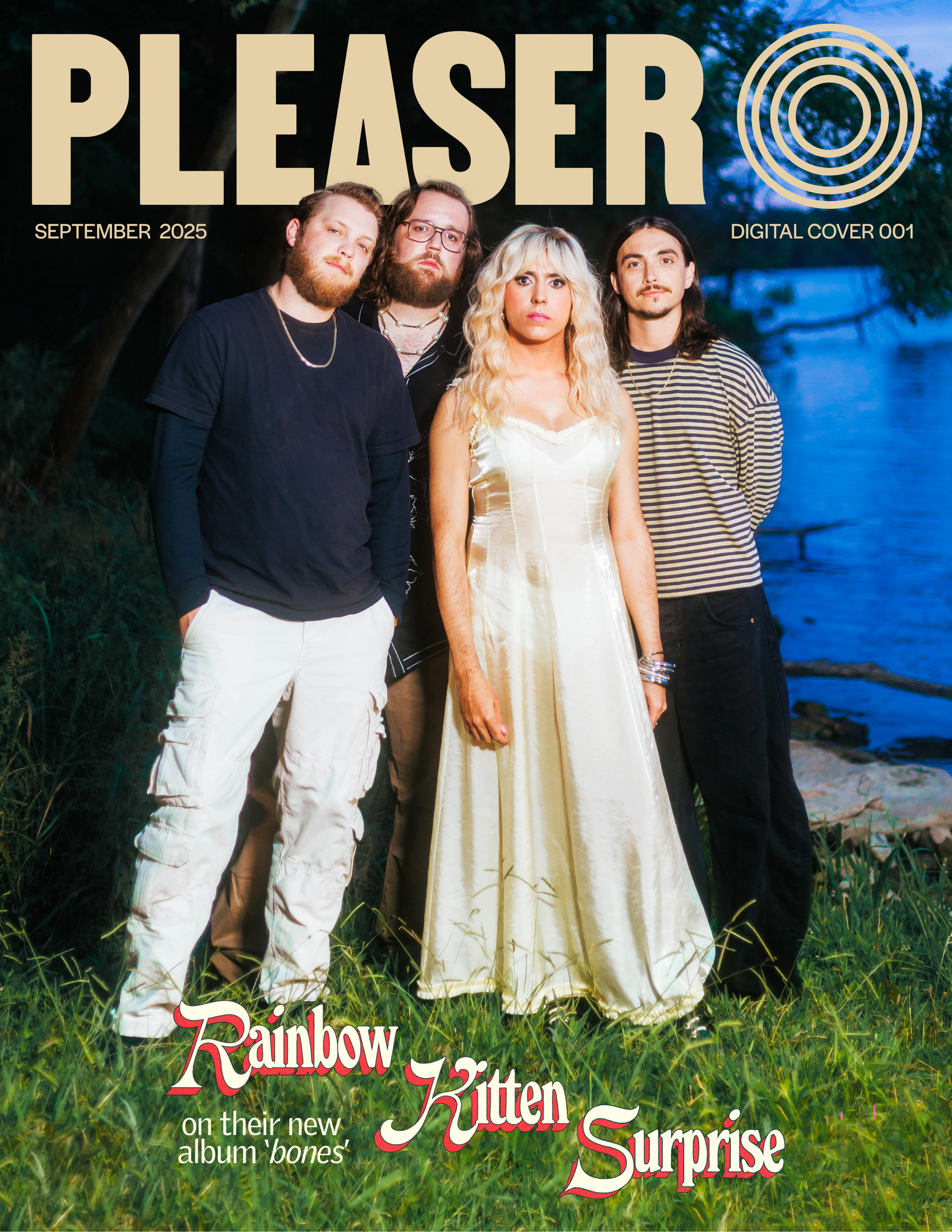
PHOTOS BY AMANDA FLORENCE // COVER DESIGNED BY SARAH DEAN MORALES
Rainbow Kitten Surprise (RKS), the Boone, North Carolina born quartet cemented as a cornerstone of the alternative music scene, is one of those bands that doesn’t just have a fanbase, but a community of devoted supporters who found themselves in their music. I spoke to a few friends about their thoughts on Rainbow Kitten Surprise, and they all had at least one song that they felt was written for them. As a long-time fan myself, I too know the power an RKS song can hold, so eclectic and nuanced in sound but simultaneously deep and personal in its lyricism. It stops you in your tracks. It’s a story being told, a feeling you’ve had but can’t describe, a relatability so surreal you get goosebumps. This is Rainbow Kitten Surprise.
In an interview with Pleaser Magazine, RKS took us on an expedition through their newest album bones. Released September 26, bones is the band’s fifth studio album, laced with the same heartfelt melodies and relatable narratives that we have come to accept as RKS standard. There is no shortage of heartache, friendship, loss, or love in this world, and with this album, RKS continues to explore these realities that resonate with all of us.
Frontwoman Ela Melo said bones came to fruition in an unconventional way; Fred again, a pop-EDM artist, reached out to the band requesting a collaboration, asking if they had any new music. Excited for the opportunity, RKS started writing and sent over 10 songs. After a request for more options, the band eventually sent over a total of 32 tracks. Unfortunately, there was no response from Fred again, but with all the new music they’d written, the band decided they might as well release an album.
“Fred again, if you're out there, we’d still love to collab’.” Melo laughed.
The album boasts 10 tracks, three of which have been previewed during RKS’ Thanks For Coming Tour this past summer. The tour started May 11 in Calgary, Alberta, and ran through cities across the US and Canada from Birmingham, Alabama, to a hometown show in Boone, North Carolina, all the way to the West Coast in Bend, Oregon. Due to popularity, the tour was extended through October to include 12 more shows to the already ambitious 31-city calendar.
Lead guitarist Ethan Goodpaster said the group thinks of themselves as a live band more than anything, as performances are an integral part of their identity and ability to connect with fans. As RKS was creating bones, or any of their previous albums, Goodpaster said they constantly imagined what the live performances would be like. Despite their familiarity with the original versions of their songs, RKS tries to change the arrangements around for live shows.
“They change over time and that helps keep us interested after playing these songs over and over,” Goodpaster said. “They’re ever-evolving and that’s something I really enjoy about the live side. Wherever we are in life affects how these songs are being translated,” he said.
One of the unreleased tracks played during this tour was “Dang,” a guitar-led track with Melo’s voice as the catalyst of the sound. The song was released July 18 as RKS’ first tease of the new album, and fans begged for more. Goodpaster said “Dang” is “the rocker on the album.”
“The first time we played it live at Jay’s studio he said, ‘Wow, I just got to watch that!’ And that made us all feel like a million bucks,” He continued.
This track harnesses the energy and spunk that permeates through a crowd during an RKS performance. Sonically, “Dang” feels timeless, reminiscent of previous RKS albums that flawlessly execute an intentional build to the chorus with a loud, tasteful finish. At the same time, the lyrics are an ode to unexpected love, representative of a passion and desire we all long for. One of RKS’ specialties in my mind is balancing the dance-ability of a song with its emotional weight. Music is a lens into the world of another, a way to connect us by showcasing the emotions we all hold onto. “Dang” is another example of RKS’ ability to mesh the joy of music with the hardship and emotion required to connect with an audience.
I’ve been working on a project. It’s called you /
And I do or die and I’m grieving love /
Better let the band play and the band plays /
Sorry got away now. Say /
Tell me not to wait now say /
Never mind just hit me up and love.
Conveying complex emotions through a rock song can be difficult, but time and time again RKS finds the ability to blend the two together. In our interview, I asked how they manage to maintain the integrity of the emotion while allowing fans to find a cathartic release. Melo explained that the feelings of a moment are usually bigger than what actually happened. What the audience receives in the beginning of a song is that initial reaction, the emotion attached. Using their 2018 hit “It’s Called: Freefall” as an example, Melo said the verses were written first, sort of as an emotional anchor holding the piece together. They didn’t add the explosive ending until later, and that ending became a central component to the song.
“The first part is a downer, so we figured out the sad part, the make you want to cry part, but how do you laugh? How do you ‘let it all go’? We always want to have a positive spin at the end, the calm after the storm,” she said. “People always say we write the happiest sounding sad music,”
Like you could let it all go /
You could let it all go /
It's called free fall /
It's called free fall /
You could let it all go /
You could let it all go /
'Cause ain't shit free but falling out /
And that shit's easy, lemme show you how it's like.
After listening to bones myself, the song that immediately spoke to me was “Friendly Fire,” track one on the record. Goodpaster said this song was the first the band tackled as a group, but Melo confirmed that it was actually the last song she wrote. On recording the track, Melo explained that the band was apprehensive at first, with nerves bubbling up and anxieties trickling in. Once the first-day jitters were out of the way, drummer Jess Haney said the experience was a good sign of what was to come. “Starting a new record is a daunting thing, but I feel like I was doing it with the best,” he said.
Relatability is a cornerstone of what creates exceptional music, and RKS feels the same way. Melo said “Friendly Fire” is a song the band plays close to the heart, explaining “We want them [the audience] to think ‘Oh, this song is about me. It’s about my life.’” Melo pointed to the first line of the song as the central feeling she was writing from: “Looking at you for the first time / Was like seeing first light at the end of the tunnel.” Moreover, Melo said the line was also pointing to the process of writing itself. “All of this hurt and confusion was coming out: ‘it breathes, it breathes, it breathes.’ People are going to interpret what they will,” she said. Electric guitar player and backup vocalist Darrick “Bozzy” Keller said “Friendly Fire” is about letting go, removing yourself from a bad situation and accepting change.
Change is inevitable in a band that’s been making music since 2013, and Rainbow Kitten Surprise has learned to deal with those moments much like any friend group. Melo said one lesson they’ve learned over the years is that “honesty is the best policy” isn’t just a catchphrase you see pasted on the wall of your friend's mom’s kitchen. It’s the only way groups of people are able to work together over a long period of time. Melo explained it best, “Everything you’re feeling is felt by the people around you, especially those that are close to you.” She emphasized that talking issues out, even ones that don’t pertain to the band, are essential in maintaining clarity in the creative process. “There can’t be any secret keeping or bottling because things fester,” she explained. Keller agreed with Melo, describing his efforts to consciously take time for himself on tour and create a space where others can express their own needs.
We also discussed change in terms of RKS’ music. Keller said the band’s 2023 album Love Hate Music Box was like stacking Legos, constructing one piece at a time, building from the bottom up. bones on the other hand took a different approach: Melo presented the songs she’d written and generally arranged, then the group “sat in a circle” and worked them out, weaving their parts together into the final demos. “It was more collaborative in that sense,” he said. Goodpaster added that the new album was also more planned out. The band had an allotted amount of time to arrange a set number of songs that needed to reach their producer, Jay Joyce, by a specific date.
Goodpaster continued, laying out their thought process. “We thought, ‘Okay we should probably have a few extra songs as backups in case we don't like how some turned out.’ We pretty methodically planned out how we were going to do it and it somehow just worked out exactly how we wanted it to.”
Speaking of earlier releases, a favorite track amongst RKS fans, demonstrated by its Top 3 status on Spotify, is “First Class.” Debuting on the band's first album Seven + Mary, “First Class” triggers a flashbulb memory: you won’t forget where you were the first time you hear it. The storyline follows the realities of a relationship that’s been tainted by time, showcasing the complications of chasing a dream while also building a successful partnership. It’s introspective in nature, requiring listeners to evaluate what really matters in their own lives.
Melo wrote “First Class” at 21, still early in her career, but the exploration of self-worth sewn into this track seems to come from an older soul, someone withered by a constant pull between home and the road. Without experiencing it herself, Melo was able to imagine a relationship ruined by the results of RKS’ ultimate goal at the time: fame. Melo masterfully incorporated repeated lines that highlight the foundational emotions on the track, namely the refrain “Say you love me like you used to.” The third verse demonstrates the cracks in the relationship, an ending that’s hard to solidify:
We were born splaying in the wreckage /
Tearing down on birds with stones /
I bore my weight upon your shoulders /
Water as warm as morning suns /
I don't think quite like I used to /
I got a bed to call my own /
I see stars and painted lies /
Broken glass upon your road /
Now I'm driving home too soon
The first few lines reveal the relationship the two have, kindred through shared struggle and a reliance on each other to get through. There’s a comfortability between the two, keeping them tied together even after one partner makes advances in their life. Through clearer eyes, the partner who’s “got a bed to call my own” sees the destruction caused by their relationship, but can’t find the courage to leave.
Haney said the band plays “First Class” every night on tour, and fans seem to “elevate” when they hear it. “That’s what makes the song for me,” he explained, “seeing so many people connect to it.” Keller agreed, stating that the song evokes so much emotion, played for either 5 people or 5,000. “It holds so much emotional weight, it's crazy how much we’ve changed and how much the performance has changed since its release. We still love it just as much as we did in the beginning,” he explained.
Up next for Rainbow Kitten Surprise, bones will be accompanied by a global tour with stops in Australia and the UK. This is the band’s first trip to Australia, with stops in Melbourne, Brisbane, and Sydney. More details about the tour could not be disclosed at the time of interview, but Goodpaster said there’s a lot of exciting music and stops to be released soon.
“We’re going to some really cool places and we’re excited for the journey.”