‘Sing Street’: Where Inspiration Makes the Artist
A look into the soundtrack of the 2016 film Sing Street and how music plays a powerful role in how we view friendships, inspirations and our own sense of self
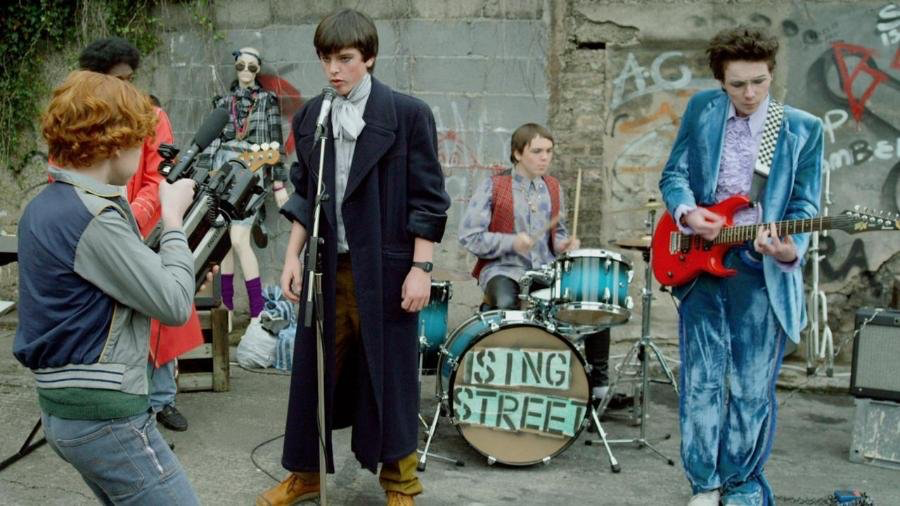
PHOTO VIA SCANNIAN
There’s something magical about finding a movie with a soundtrack so powerful that it makes you look off into space and think, this is going to change everything I’ve ever known. Maybe you’ve never even considered a soundtrack or score until that point, and now every time you watch a movie, you let the music guide the story. It’s like when you lift into space with the score in Interstellar, or how you tear up every time you hear “My Heart Will Go On” because of Titanic’s tragic romance. Our emotions are heightened when music is played in a film, and we discover a new perspective on life because of it. For me, my movie soundtrack moment happened ten years ago, from none other than the 2016 indie film Sing Street. A beautiful story that taught me the precious, real way that music is made, and bands are formed.
This film, directed by John Carney and composed by Carney and Gary Clarke Jr., is the fictional coming-of-age story of 15-year-old Conor Lalor in Dublin, Ireland, in 1985, who transfers to a new school due to the financial distress caused by his parents’ separation. Conor and his two older siblings, Brendan and Ann, face the struggles of this separation and try to keep each other's spirits up with the simplicity of music. One day at Conor’s new school, an all-boys Christian Brothers school, he meets a mysterious girl after class, Raphina, whom he immediately wants to impress. He finds other students to help him form a band (calling themselves “Sing Street”) as a way to get her attention, and soon they develop music that takes them away from the bleak reality of their lives. Through heartfelt lyrics and melody, the boys find brotherhood and an understanding of who they want to be.
The story itself is enough to make you hug your closest confidants and motivate you to obtain your dreams, but with the added music, you drift into a masterpiece of love, hope and persistence. Yes, music tends to make every film just a little bit better, but this movie in particular would not be what it is without its music, because it articulates the realistic truth that all musicians face at the start of their careers: creating art sometimes requires finding your inspiration first to discover what kind of artist you’re meant to be.
So, how does the film’s music exactly connect to this theme? Allow me to explain. The entire soundtrack of Sing Street is a mix of real ‘80s songs and songs created by the band, with a hint of Adam Levine at the very end. As the movie goes on, we learn that many songs Conor listens to, whether with his siblings or bandmates, inspire the ones Sing Street creates. It’s very intentional with what songs from the ‘80s are played. When we see the characters listening to them, it makes sense why Sing Street’s notes and chords are comparable to the fictional band’s contemporaries. Some of the most notable pieces and the band’s self-made counterparts include:
“Maneater” by Hall & Oates and “Drive it Like You Stole It”
“Rio” by Duran Duran and “Riddle of the Model”
“In Between Days” by The Cure and “A Beautiful Sea”
Through these songs, you will not only hear but feel the similarities, from Hall & Oates’ jumping saxophone to Duran Duran’s quick-fingered synthesizer. The band brings thoughtful inspiration that shows not a copycat style of the original music, but rather an admiration with their own personal twist.
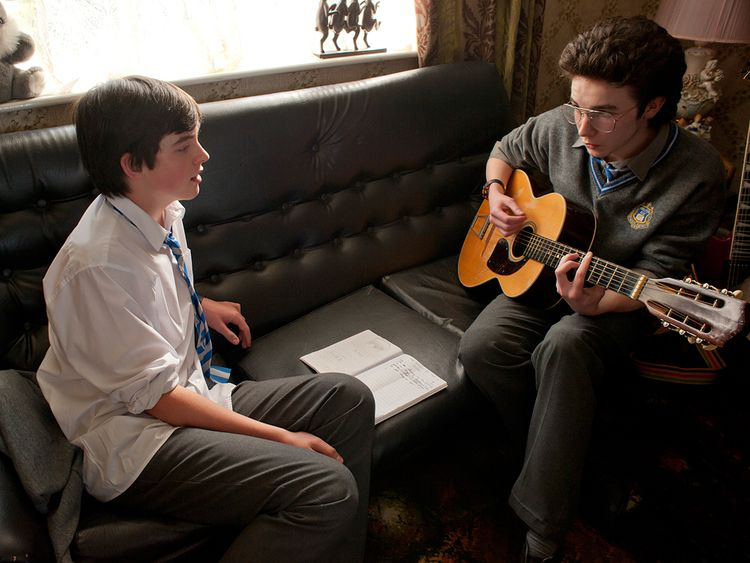
PHOTO VIA PEOPLE MAGAZINE, 2016
It’s even fascinating to watch the band as they make their music throughout the film. They start with rugged, out-of-tune music sessions that slowly become smooth and confident, like it’s been a natural part of their lives for years. The film doesn't force the idealistic musical connection that is common in band movies (like Lemonade Mouth) where they display everyone picking up an instrument right as they meet each other and creating instant harmony (no judgment towards Lemonade Mouth, though. I can sing every word of its catchy, well-produced soundtrack). Yes, bands that bond well will have an easier time finding their flow, but I appreciate Carney’s vision to show how some bands need those sessions where nothing meshes and no one is in sync; it makes the end product much more meaningful.
Personally, one of my favorite parts of the film is the making of the song “To Find You,” with lyrics written by Conor and the sound completely created by him and Eammon, one of Conor’s bandmates and close friends. There are no ‘80s song influences; it’s an original song that has a slower tempo compared to the upbeat style of the band’s other music. However, upon recent discovery, I realized this song might actually have a callback within its title. In the scene where Conor first meets Raphina, she asks him to sing a song to prove he’s in a band. She has him sing the chorus of “Take on Me” by A-ha, which has a line that goes, “to find you/shying away.” Though it could be a complete coincidence, it fascinates me that the song Conor creates to honor his hopeless adolescent love for Raphina is also called “To Find You.” I’m going to believe this tie-in was intentional, even if it wasn’t, because it makes me love the messages behind the music even more.
Though we see the making of the song, it is not shown in full until a moment when Conor feels so much for Raphina that he throws these emotions into the romantic piece of musical poetry. With lyrics like:
Gotta find out who I'm meant to be
I don't believe in destiny
But with every word you swear to me
All my beliefs start caving in
Then I feel something's
About to change
The song is meant to be that breakthrough moment of passion when an artist finally finds their own path in music, no longer needing that heavy influence from specific songs. It’s obvious that our inspirations will always live in the background of our work, but over time, we find ourselves able to make art that builds our own sense of identity. The song never fails to make me cry, both for Conor’s love, as well as for how much music has helped him discover his path and overcome the stresses of his home life. Carney wants the audience to learn that, as an artist, no matter the medium, you should use your art as an outlet, as a way to find yourself or even let it be a release from negative energy.
When I first watched this movie at age 16, I was awestruck by how good the soundtrack was and how well you could hear the ‘80s music intertwined with the band’s, but now, ten years later at 26, I understand the incredibly real way that music is created. Being an editor at Pleaser for a year now, I’ve read multiple interviews where artists address their biggest inspirations and how they’ve developed their songs from many of the bands that originally gave them their love for music. Being able to hear how many artists started making music based on their idols helps relieve the pressure for a new artist coming in, who may assume that what they create must be completely original, or it’ll never truly be worth listening to. With how much the music community has grown in genres and artists alike, finding that originality may seem intimidating, but it’s not impossible. Sing Street tells aspiring songwriters and bands that as long as you have the passion and persistence, your own sound will come, and that having inspiration from other artists doesn’t make you less of one, it might even make you better because of the appreciation you hold.
The film also says a lot about finding the people that work well with you, the friendships that you build and how a band is much more than a group of people creating music. You need the chemistry for it to work, and after seeing how all these real artists developed their own bands, I can see just how real the portrayal is in Sing Street.
If you haven’t seen this film yet, I can’t recommend it enough. It’ll have you laughing, crying and swooning all at once. Take in every song, every lyric and every piece of dialogue. Warning: you may fall in love with the music and listen to the soundtrack on repeat for an entire week. You’re welcome in advance.