Two Lip Mania: The Two Lips on Artistic Authenticity, Womanhood and the Twee Revival
As The Two Lips emerge into the mainstream, they reflect on their priority of authenticity in an industry that incentivizes practiced perfection.

PHOTOS BY EMILY ENTZ
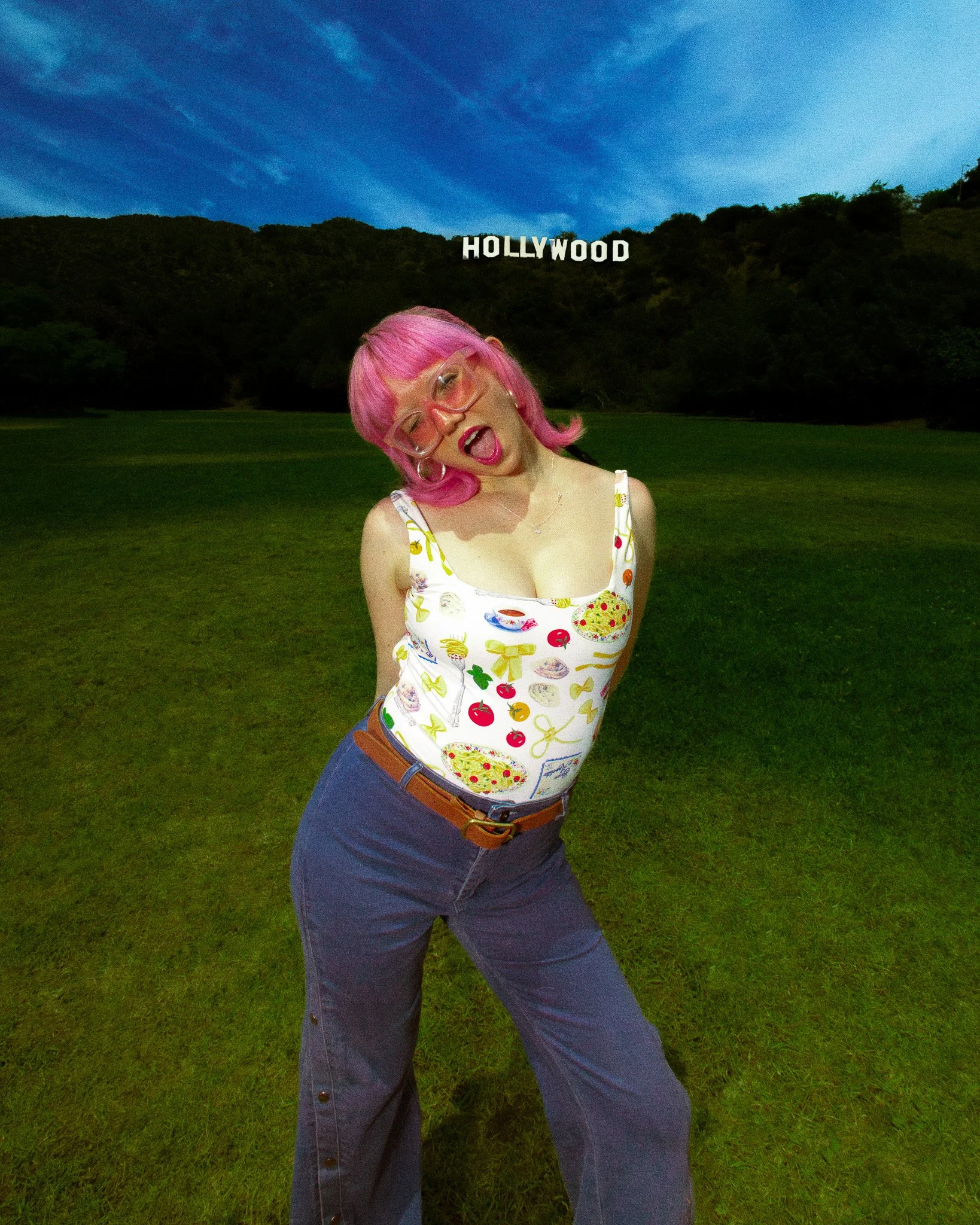
In the closely manicured glade of the Hollywood Reservoir, situated at an angle, directly beneath the Hollywood sign, everything becomes an ephemeral blur by design. Tourists and influencers scale the steep road, rushing for a picture here, fiddling out a TikTok there and dashing back to parked cars in adherence to the fifteen minute parking limit awarded to places as frequented as this one. It’s a disorienting place with few points of anchorage or grounding. There is the Hollywood sign, remnant and presiding, arcing forth like a monument of some religious pilgrimage, and there were The Two Lips (formerly known as The Tulips) beneath it, who too, emerge antithetically, sprouts of clarity and edifice.
“I think a duo is so powerful,” Andrea Flores said, emphatically. “Us being two women—we both experience things the same way.… When you’re a solo artist, it’s more of the weight on you, but when there’s someone else there, it’s validating.”
Since 2023, Andrea Flores and Julia “Jewlz” Gurule have been circulating the indie scene as a duo, captivating audiences with their half-winking, half-wide-eyed style and sensibility. Up until a few months ago, The Two Lips were still cutting teeth on royalty-free Youtube audios, GarageBand mixes, makeshift studios etched out on bedroom floors, and college town hole-in-the-wall performances. These humble beginnings indicate, above all, The Two Lips’ dedication to their craft, wrestling it from the smothering scrap heap of adulthood responsibilities—jobs, relationships, graduate school—and treating it not just as a priority, but as an honor, an oath. Think of their home studio as an altar, the small-time shows as ceremonial rituals, the lyrics written to copyright-free backing tracks as hymns.

Even as their studios grew more equipped, their audiences swelled, their access and opportunities multiplied, The Two Lips’ authenticity remained fixed. The Two Lips are disinterested in chiseling themselves into rigid Hollywood stars. After signing under Island Records, The Two Lips are now in the rare and marvelous position to expand on technicality, while still honoring the sentiment.
“We are having whole new work opening up,” Gurule said. “We’re really excited to keep living… We have so much more room for authenticity and more room to grow.”
In conversation, The Two Lips were bright and engaging, answering in lilting cadences; one completing the measures of the other’s sentences in harmonious coordination. Bright and engaging, they answered in lilting cadences, explaining how their duo formed out of mutual follow on X (formerly known as Twitter), and materialized into an actual friendship when they took to social media to Tweet through their respective relationship issues, interspersed with hyperlinks to songs from Lizzy McAlpine’s Five Seconds Flat. Soon enough, the two went to Alpine’s Constellation Room show together and the rest is history.
“That was our first hang out and it was really beautiful. And then that’s where we went, ‘Okay, we’re friends. Now let’s see how this can go,” Flores mused, recounting their first meeting with respect to all that followed. “Music really brought us together.”
Most of The Two Lips’ discography was recorded during those early days. Compositionally, the songs are very simple—profuse in delectable harmonies, textured by the occasional vocal layering, and strategically vague lyricism—but are saturated by the listener’s internal experience. When listening, The Two Lips’ music becomes a soundtrack to life—any life, it doesn’t matter which one.
To feel the twinkling chorus of “favorite apple” fall like autumn leaves, or to taste the honey-sweet sickness of yearning from “Joel” chiming in through melodies mastered on bedroom floors, written in cafes between part-time jobs waiting tables and teaching preschool students, is to feel the crushing emotion of any given moment. The Two Lips’ early songs are love letters written from the cusp of discovery. They are delicate and disarming, a Trojan Horse for the deeper contemplation and deliberate self-discovery they hope to incur in their newer music.
“We’re not girls, we’re women now. We’re trying to embrace our maturity,” Flores said, gesturing vaguely to herself and the early noon picnickers and dogwalkers around her.
“We’re about twenty-five now,” Julia “Jewlz” Gurule concured, “This whole new era is us leveling up.”

The Two Lips are practitioners of a modern magic, steeped in mystique and incantation, invoking a rather commanding presence in both the digital world and the real one. The Two Lips’ live shows are treated with the same detail and care. They recounted their choreography practices in Gurule’s living room and their outfit coordination. They explained that their efforts have been picked up on by their fans—referred to as Petals—who have dressed in theme with the shows or appreciated The Two Lips’ on-stage dances. The Two Lips’ music is at once an intimate act and a character study.
Their widespread popularity is largely attributed to their song, “still love you (todovía),” reminiscent of one of The Two Lips’ major influences, The Marias, “still love you (todovía) is a gem in their discography for its steady tempo and precious yearning. The first verse opens, “I’d like to think that you know me very well but / I think you know me better than I know myself.” The Two Lips harmonize over the dusty drums and soft lo-fi beats that summon themselves over and over again in the listeners’ head. The Two Lips’ musi does not necessarily penetrate the listener with spectacle or force, but enlighten it through some sort of persuasion or enchantment. With its gentle melodic palpations, its simple, yet raw lyricism, “still love you (todovía)” kicks up feelings of fables and undeclared or unrequited love. Within hours of posting the clip of the song, “still love you (todovía) and The Two Lips, went viral on Tik Tok.
“It was very surreal to see,” Flores said, recalling their experience waking up to thousands of new likes on the bite-sized snippet of the song. “It was the universe telling us, ‘Keep going.’”
“It really was meant to be,” Gurule elaborated, locking Flores’ gaze, smiles blossoming across their faces. “It really changed the trajectory of our lives.”

Among their influences are a few indie pop offerings such as The Marias and Clairo, but also icons of Twee pop like The Sundays and Camera Obscura, the genre of feminine alternative music characterized by light, swinging melodies and ostensible cuteness that sometimes veiled dark and sordid subject matter. The Two Lips, with their lively, intrepid charm and their distinct coordination, fit well into a twee world of emotive contradiction that is equal parts saccharine and subversive, an idiomatic sequence of vulnerability and wit.
“If indie sleaze is coming back, twee pop should also come back,” Flores laughed. The Two Lips reinterpret these sounds through their own lived lens—one steeped in introspection, humor, and a uniquely modern sense of selfhood.
The Two Lips explained their writing process as a carousel of inspiration and vocation. At times, they challenge themselves to write from the perspective of film characters (“Joel” was partially inspired by the protagonist of The Eternal Sunshine of a Spotless Mind), but much of their work is inspired by shared experiences that relent to shared philosophies. The Two Lips’ converge on a sort of communal womanhood; a womanhood composed of dim bedrooms and backlit bars, friendships founded on sympathy pains, equal parts vice and charity. For this sort of womanhood, the pretty, inconsequential expressions of girlhoood would not suffice.
“We didn’t want to center all of our music on just being about love and men,” Flores offered while expanding on the new direction their music is taking.
The Two Lips referenced their latest release, “Talk,” released June 27th, 2025, as the flagship of this bold expression of womanhood. “Talk” employs The Two Lips’ signature sparky melody, happy tempo, and catchy chorus to broach the difficulty of adult communication. As always, the song is one-size-fits-all. It could be about lover, a friend, a parent, a stranger.
“It’s so hard to communicate with people these days,” Flores said, explaining how the song was inspired by a practically existential struggle to communicate effectively, especially as adults.
Womanhood, as narrated by The Two Lips, is a subject explored best at a compositional level. Womanhood is The Two Lips listening closely—to themselves, to each other, to the quiet moments between jobs and heartbreaks and half-eaten breakfasts. It is the art of gathering all the little details that tend to be lost in translation and turning them into shrines to music and self. They are not merely documenting a coming-of-age, but consecrating it; making music not just about womanhood, but of it. In a city often obsessed with polish and performance, The Two Lips stand apart, not by outshining the spectacle, but by stepping outside of it entirely—crafting something quieter, more enduring, and defiantly real.