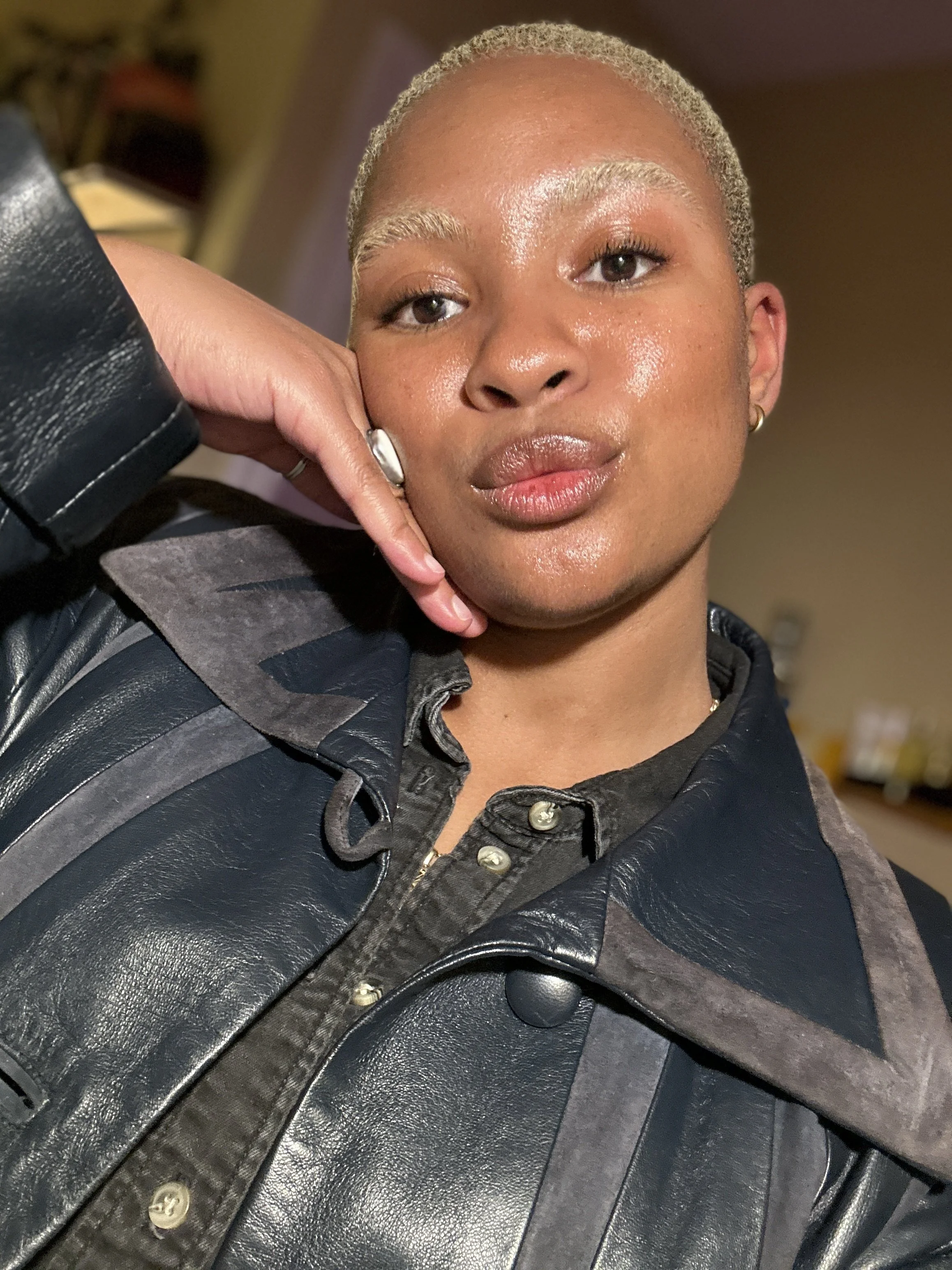
Meet Mykel
This LA-based, ballad-driven pop songstress talks hometown dreams and the mysteries of the universe with Pleaser.
Mykel bet on herself at a young age. After leaving her hometown of Salt Lake City at nineteen to pursue music full-time, she’s been grinding in LA’s music scene ever since. Her forthcoming EP, Hometown Runaway, reckons with how fragile life can be when it’s hitched to a dream. Pleaser sat down with her to hear more about what this EP means to her at this moment in her career.

Photo courtesy of the artist. Shot by Jerry Sun.
PLEASER: I’d love for people to get to know a bit about you first. What is your background, and what got you interested in pursuing music as a serious career?
Mykel: I feel like music is the only thing that I never chose. I feel like it chose me — which is kind of cheesy, but that's just the reality. I come from a family of professional athletes. So as a kid, when I was dancing on top of cars my parents were like, ‘Oh, okay we gotta do something with this.’ They threw me in any performing opportunity that I could and voice lessons and all the things. I got my start in musical theater and jazz and then around my senior year of high school was like, I want to tell my own stories, and started diving into what writing would look like for me. I had one connection in LA and he would do Lifetime movies and stuff like that. He was a composer. So he did my first EP right out of high school and then I was like, ‘That's enough. I want to go there.’ And so I saved up and at nineteen dropped out of college in Utah and went out to LA and I've been here ever since.
Since we're talking about your background, I know you're originally from Salt Lake City (SLC), and SLC is having such a big cultural moment right now. We've got shows like “Real Housewives of Salt Lake City” and “Secret Lives of Mormon Wives,” which are really putting your city on the map in terms of mainstream culture. Where do you feel like your perspective and your music fits into this emerging cultural tableau of SLC?
M: “Secret Lives of Mormon Wives” is actually filmed in my childhood neighborhood. All those girls went to my high school. And I have friends of friends, and people that I've known that are there. My friends’ houses are in the background of many of their scenes. It's a very interesting thing to watch that come to the forefront of pop culture. But this whole EP, Hometown Runaway, is exactly about that. I ditched it all at nineteen, being like, ‘Okay, I'm out of here. I need something more.’
But LA did not go as I had planned. I'm not a nepo baby, you know? I’m out here grinding and fighting for my life, realizing the reality of what chasing your dreams is, losing myself, wanting to change things about myself, and then this whole EP is that coming back to self of like, ‘Oh, people are multifaceted.’ I don't have to erase who I was to be who I am, to get to where I want to be. All of this can be together. That's my message as a person and what the EP is about. So it's hugely informed by my Mormon upbringing and by Utah culture. There's a song on the EP called “Drag You Down.” That's just about like, ‘Alright, if I'm going to be the bad example, devil, deceitful person that y'all say, then I'm going to be the best at it.’ And I'll arrange a song about that, but then there's also so much good and so much community, and it was a wonderful place to be, and so much of who I am and my moral compass comes from that, and I don't think that’s a negative. So, you know, I've come to terms with it all.
Who are your musical inspirations? What influences your sound?
M: Growing up, it was any big vocal queen. Like, Christina Aguilera and Whitney Houston. I loved Etta James, Aretha, even Evanescence. Any big expressive vocalists really resonated with me.
I can hear that in your music, too. I can hear the big ballad vocals from you. And I can hear your theater influence too. Along those lines about your vocal style, how would you characterize your music for someone who might not have heard you before?
M: Honestly, I would say that I am anthemic R&B-influenced vocal melody with pop production. And then throughout my entire career, I've dived into super EDM dance with big vocals on top or, you know, the ballads with the big vocals. I mean, we're increasingly in a genreless lane these days, which I love because then I can tell my story and use genre and influence as a way to portray emotion and further the story instead of having to lock myself into one type of thing.
Do you feel pressure to try to fit into a category sometimes?
M: Totally. And I think I did. I think I very much used to be that way. I also started writing for sync licensing, which is like movies, TV and film music. In that lane you're given, essentially, a brief and then it's like, ‘Okay, how do I fit this vibe, but make it general?’ Right? So my whole mindset was kind of that less personal pop, where it was still coming from real emotion, but I was thinking, ‘Okay, how do I say this in a way that appeals to everyone?’ And I kind of accidentally let that bleed into personal projects. And I love them all, they all serve their purpose. I wasn't doing it necessarily consciously. But in kind of going through the car accident that I went through, and giving up and leaving music, when I came back to music, it was just for me. Like, I was not even anticipating this EP being a project, when I wrote “Brace for Impact,” which was the first song for the EP. It was literally just, I need to do this and it's about me. And it's very journal entry style lyrics. It's nothing groundbreaking from a poetry standpoint. It's just like, this is what the f*ck I'm feeling here and I need to get it out or I'm going to freak out. That's kind of the catalyst for this project, which is me officially letting go of any sort of notion of what I need to be doing at all.
Can you talk a little bit more about “Brace for Impact” and the car accident? It sounds like you had a significant life experience that has fundamentally shaped you and your music-making.
M: I was eight years into LA, still just barely making ends meet, struggling, working a hundred different odd jobs, burning myself at both ends. And then I was on my way to Death Valley with some friends and our back tire seized up out of nowhere. We swerved and rolled four times, the length of a football field, off the freeway. And I walked away with severe whiplash and PTSD, and that was it. No other physical injury. And, yeah, it was very jarring. I should not be here. I don't have an explanation.
And with that experience came that intense ego death of like, ‘Okay, people more deserving than me don't survive stuff like this. Why am I here?’ I left my family at nineteen to pursue something, objectively selfish. What am I doing? I'm not happy. How long am I going to white knuckle this until I just — I need to enjoy my life. And I couldn't afford therapy at the time. So that was very much the catalyst for me detaching completely, which is kind of my whole essence now. I'm letting the universe guide things where they're supposed to go. I'm still going to be guided by the things that I'm passionate about, but my level of needing to prove something is gone completely.
Thank you for sharing, first of all. That's traumatic. And I'm glad that you're still here. I am curious how this experience weaves into your upbringing, especially with the religiousness that's prevalent in Salt Lake City. Did this cause a crisis of faith in any way?
M: It definitely shifted my relationship to faith. I've always been a questioning person. Even growing up in the thick of Mormonism, I was always the one that was like, ‘Okay, this, I like. This, I don't like. What's going on here?’ I'm not just going to do this because you said, like, what do you mean? And so that crisis of faith was kind of that my entire time in LA felt like one giant unraveling and trying to find things out. And then I think that accident actually kind of just brought me back to neutral. One of the songs on the EP, too asks, ‘How do you know? How do you know what you’re really wanting? How do you know?’ And the reality is you don't. And that's kind of the point of life. However you want to spend it, whatever God you want to believe in, you're not going to know. And being able to sit with that and see how faith can be a tool to help keep me grounded as a person instead of seeing it as this dictator of how exactly things need to be. It very much reframed my relationship, but I'd say it's fixed the crisis of faith instead of making it worse, ironically.
Who do you hope your music finds? Who do you want to hear this project?
M: I mean, obviously, I want people in my hometown to hear it, right? I want that nuance on a large scale to reach them. But I think it's anyone in that middle ground. It's been really weird being in the middle of things for a long time. Too Mormon for everybody else, not Mormon enough for my community, you know. I'm in the music industry, but I'm not famous enough but I know a lot of cool people. Just constantly being in the middle. Even with arguments, I'm a very middle-of-the-road kind of person, intentionally, not in a waffly kind of way. I want people like that to be able to accept every facet of themselves. I think people in my position are people who have ever left home in chase of something greater. Or even if you didn't leave home. If you mentally are taking risks to chase something and it doesn't go to plan, still being able to trust in the universe or in your God or in yourself, like those kinds of people, I want it to find them because I think, you know, if one of us can do it, all of us can do it. Like, truly, I'm not special. Nobody's that special.
Mykel’s EP Hometown Runaway releases on November 7. This interview was edited for brevity and clarity.