ALL IS LOVE AND PAIN IN THE MOUSE PARADE: NANNA HILMARSDÓTTIR ON OF MONSTERS AND MEN’S PERFECTLY TIMED RETURN
Of Monsters and Men established themselves as pioneers of optimistic indie folk-rock with the joyously infectious, “Little Talks.” After years on the road and some time spent growing independently, the Icelandic group shares their reflections and revelations on All Is Love And Pain In The Mouse Parade, perfecting their symphonic yet soft sound and making peace with their journey so far.
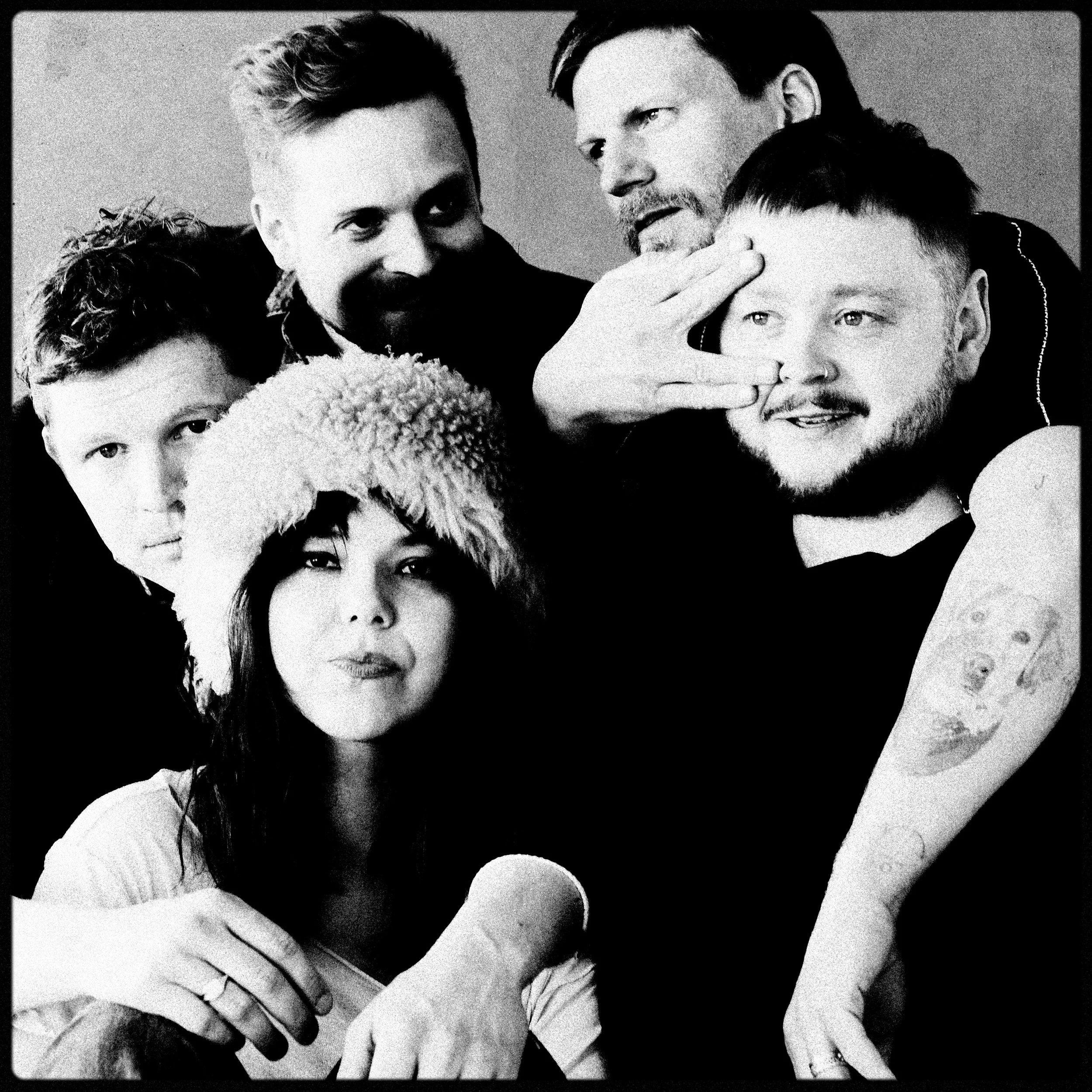
PHOTOS BY EVA SCHRAM
As we begin our autumnal retreat, we settle into our homes and re-familiarize ourselves. The dusk creeps in earlier and earlier, rehashing the wistfulness we’d buried under the wide-eyed sentiments of summertime.
Of Monsters and Mens’ latest record, All Is Love And Pain In The Mouse Parade, is their first in six years — and it’s arrived just in time to soothe our autumn existentialism. Together, on the album, bandmates Nanna Hilmarsdóttir (singer and guitarist), Ragnar Þórhallsson (singer and guitarist), Brynjar Leifsson (guitarist), Arnar Rósenkranz Hilmarsson (drummer) and Kristján Páll Kristjánsson (bassist) embrace isolation, introspection and observing the intricacies of everyday surroundings.
Hilmarsdóttir spoke to Pleaser about how the record threads memories and conversations into a musical tapestry, stitched with grand piano strokes, tender harmonies and drums that echo like clapping hands. Read our conversation below, in which Hilmarsdóttir discussed special additions to All Is Love And Pain In The Mouse Parade, the records’ big-screen moment and bringing Icelandic music across the globe.
Pleaser: Your last release, Fever Dream, expanded upon your abilities, reaching out sonically and thematically. All is Love and Pain in The Mouse Parade seems to be more of a work of looking in, perhaps a more intricate use of a smaller space. What’s been going on in your lives these past six years that has influenced the path this record has taken?
Nanna Hilmarsdóttir: It’s interesting you say that. I’ve almost noticed a pattern, and I don’t know if we’re breaking the pattern this time around. We make a record and it has a certain feeling to it, and then we completely go the other way for the next one. Like for the record, My Head is An Animal, it’s such an expressive record — us in our early twenties being wide eyed. Then we did Beneath the Skin after touring for a long time. We had come back home and it became like an Icelandic winter, introverted and more serious in a way. Then with Fever Dream it’s playtime again and we were exploring different sounds for us.
What has happened in the past years, there’s been a lot. Starting homes, starting families, giving ourselves time to do other things that we hadn’t [been able to before]. Growing a lot as individuals. When we started to work on the record, dipping in and out over those years, that’s very much what inspired this album. A sense of community in returning home.
The album feels personal and communal at the same time. I had seen Ragnar previously use the analogy that these songs are built like letters sent back and forth. Does this mean the songwriting was done separately and then combined, or it was still written together?
NH: Both. Somebody brings something to the table and shows it to the rest of the band. Or sometimes we are in the studio, someone starts playing something and it feels really good and natural. That’s how “Fruit Bat” came to be. Arnar was playing the piano, this melody…and we all started building on it. There’s no real rules, it’s just whatever feels good in the moment.
The balance of your and Ragnar’s vocals emphasizes that communal feeling. It’s so special that Of Monsters and Men utilizes that harmony instead of a lead and backing vocalist. Another element that is a little bit of a signature for you guys is horns, like the ones that build on the track “Television Love”. The brass section is part of what made “Little Talks” so novel.
When you have such a breakout success like “Little Talks,” how do you distinguish that art from the era you’re in now?
NH: There are things that make you who you are and that’s just how you write something, that’s what your language is. As an artist, you may not even realize what those things are. It’s always the people in the band making it and where it takes you in the moment. [But] we’ve had those conversations of songs that feel very different. Maybe they are living on the same record, or if there’s a lot of difference between records, and [the band asks] this question of “Is it too different?”
Were there any tracks that were contenders for All Is Love And Pain In The Mouse Parade that raised that question: “Should this live here?”
NH: Yeah, with “Barefoot in Snow,” that almost didn’t make the record. It’s purely because…we were trying to find the right clothes, the right arrangement really. We realized at some point that the demo felt very authentic and real. What you hear now on the record is basically the demo. And that’s from back during COVID, Ragnar’s singing alone in his apartment locked away from the world. You can’t really recreate that isolation.
That track is truly raw and in real time. “Dream Team” is very from the heart too, and I hear it has a part to play in the film, A Big Bold Beautiful Journey. I always wonder if the way songs are used in the film matches what the artist may have visualized for the piece.
NH: It’s cool. We’ve been lucky to have a few moments like that. I always love it, the conversation between film and music is such a beautiful thing. On our first record, the movie The Secret Life of Walter Mitty, we had a song in there. It really fit the scene so well.
I would imagine it’s cool to see your work through someone else's eyes.
NH: Yes, how they hear it. How it makes sense to them.
“Dream Team” being included in A Big Bold Beautiful Journey further proves your reach far past your homeland. I’m curious to know a little bit about Iceland’s relationship with the music industry. Do you feel it’s more challenging for Icelandic artists to reach the international mainstream?
NH: Yes and no. With how the world works today with the internet….I sound like such an old person when I say that! But it used to be very hard when we were just starting out. At that point you just had Björk and Sigur Rós. Now, I feel like people are more in tune with the Icelandic music scene — [like] Laufey, who has had massive success. There’s a lot of music here and a big music community…it’s getting easier and easier. But it’s still hard when you’re starting out you don’t have a lot of funding behind you. Having to get yourself off the island to tour is not something everyone can afford.
You previously stated that Iceland is an anchor for this album. Are there any specific lyrics or sonic elements that spotlight Iceland?
NH: When you live here…I think we’re very used to harsh contrasts. It plays a huge role on this record. I think the influence is there in the imagery. When I hear these songs, I think a lot about my childhood. Where I grew up there is this beautiful lighthouse that is very much a place in my town that centralizes, draws you in. There were all of these buildings I could think of — isolated places that feel very big and cold, but there’s beauty all around them. There’s a lot of images of [those] buildings.
You have some warmer, homey scenes on the record too, like in “The Block” and “Mouse Parade.” Is it true that a lot of the sounds used were personal recordings and effects?
NH: Yes, definitely! We kind of connected those two songs. You start with “The Block.” There’s this high rise building that is the pillar of human struggles. The idea was that you travel all the way down it beneath the floorboards with these creatures, hearing what they’re hearing. They’re living their own lives filled with love and pain and history. When we were recording it, we placed a lot of mics around the room and shook things and rolled around on the floor in bubble wrap…we were so deep in it.
You guys were really embodying, “There’s a vision, trust.”
NH: Yes, we recorded my dog sniffing and searching. A lot of voice memos of our friends. The vocals in that are our friends that are incredible musicians here in Iceland and are a part of our community now. We wanted to have them on this song. We wanted them to sing in unison to feel that the community was telling the story.
Well I hope these friends and the mice below the floorboards get to hear these tracks and feel appreciated! Lastly, I see that you guys will be returning to the tour circuit for All Is Love And Pain In The Mouse Parade. Considering this album is intricate and quite tender, how will that come to life on a live stage?
NH: We’ve found that it’s very natural to play these songs. We honestly had problems with our last record when we were playing it [live]. It took a lot of piecing together. For All Is Love And Pain In The Mouse Parade, we just took to playing it and it felt good. I think a part of that’s because a lot of the songs are written in that way. The groundwork is there…the song first, then production. We had felt that it would be really important for us to be on the floor together playing. It means that now when we’re practicing it’s a lot easier. And it feels so nice.
It’s important that it comes naturally. Is there a song that you’re eager to see the audience’s response to in person?
NH: I’m excited about “Fruit Bat.” It’s a very long song. I just get into this space in my head, even when we’re practicing it, that I could play it forever. I think it’s one of those songs where we really connect as a band. We build this thing up.
And you intend to play it in full?
NH: Yes! It will probably be longer live!
All Is Love And Pain In The Mouse Parade is out now and yours to behold. It’s a record best indulged as the soundtrack to a contemplative evening walk, soaking in its symphonies under the fading glow of the sun. To completely immerse yourself in the “Mouse Parade”, catch Of Monsters and Men on tour starting this autumn. They’ll be marching into North America on October 28th, kicking off the circuit in Toronto, Canada.